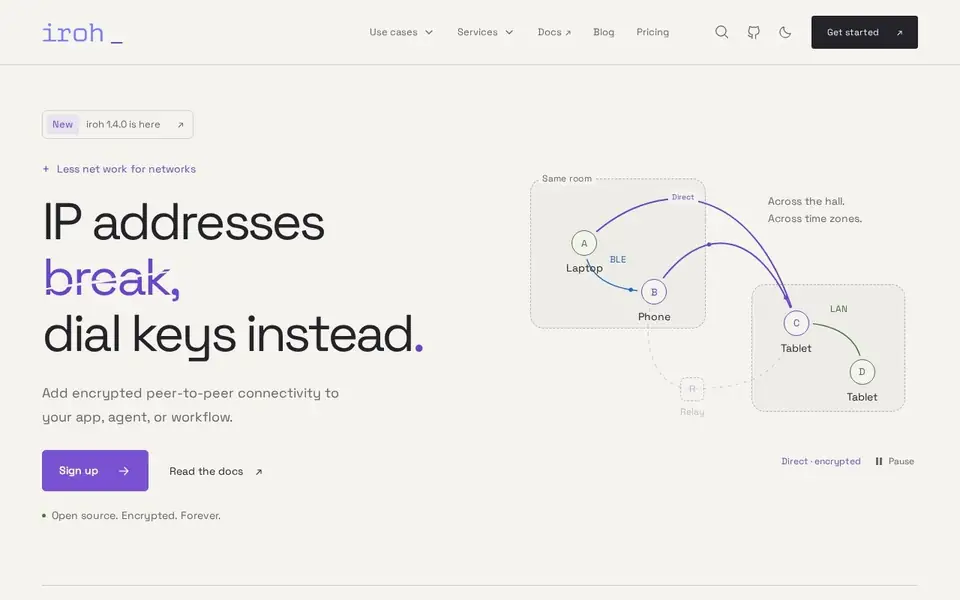
iroh starts from the observation that IP addresses break: they change, they are behind NAT, and they assume a network topology that laptops and phones do not have. Instead of addresses you dial keys, and the library establishes encrypted direct connections between devices, falling back to a relay when a direct path cannot be made. The tagline is Less net work for networks, and the project is open source.
The documentation positions it by workload rather than by protocol trivia: remote access, distributed AI, video streaming, data sync, payments and point of sale, and IoT and embedded devices. Service pages cover hosting, observability and enterprise. A release banner at capture pointed to iroh 1.4.0, and the homepage diagram shows the practical shape of the model, with devices across a cellular network, a LAN, Bluetooth and time zones connecting directly when they can and through a relay when they cannot.
Pricing is published and tiered. Community is $0 a month to start. Pro is a $19 a month base with usage-shaped limits, including egress and support tickets, and Dedicated is an add-on to Pro at an extra $199 per month per region for running your own relay in a chosen region with more control. The comparison table lists what changes across tiers, including concurrent connections, custom regions for lower latency, version locking and rate limits, with Enterprise handled by conversation.
The commercial layer is hosting and support around an open library, not a lock-in service: the plan structure assumes you may run the library yourself and pay for relays, metrics and support when you would rather not.